



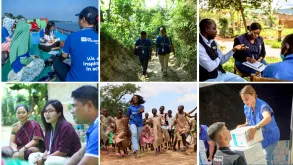
In a time marked by climate shocks, conflict, economic uncertainty, and widening inequality, it is easy to overlook one of the world’s most powerful sources of resilience: volunteers. The designation of 2026 as the International Volunteer Year by the United Nations is more than symbolic; it is a call to action for governments, organizations, and communities to fill this gap and recognize and invest in the power of volunteering.
Globally, over 2.1 billion people volunteer every month; that’s one in three working-age adults. These individuals are not just filling gaps; they are driving progress toward the Sustainable Development Goals, bridging humanitarian and development divides, and strengthening social cohesion. They care for neighbours, protect forests, mentor young people, and respond to crises long before institutional help arrives.
In the Global South, volunteerism is diverse and often unseen – informal and direct volunteering dominate; families, villages, faith groups, youth networks, and women groups form the backbone of community resilience.
Africa exemplifies this spirit: 58.5 percent of working-age Africans volunteer monthly, the highest regional rate worldwide. The African Union’s recent report highlights how traditional and modern forms of volunteering permeate culture across the continent, reinforcing resilience and development. Traditional mutual-aid systems such as umuganda in Rwanda or harambee in Kenya have sustained societies for generations.
Today, volunteerism in this region is increasingly modern, organized, and economically consequential. In Kenya, volunteers contributed an estimated 669 million hours in a single year – equivalent to 3.66 percent of GDP. The country’s National Volunteerism Policy recognizes volunteer work as a strategic asset in national planning, not a goodwill gesture.
In Rwanda, community-led service through umuganda builds schools, restores infrastructure, and deepens civic trust: a social contract in action. In Ethiopia, where the UN launched regional findings of the last UNV State of the World’s Volunteerism Report, volunteers are essential partners in emergency response, climate adaptation, and basic service delivery.
In South Sudan, young volunteers facilitate dialogue in communities recovering from conflict and deliver education support in displacement sites. Even where systems are fragile, volunteerism persists. These examples show how volunteerism is not supplemental in Africa; it is foundational.
Despite their impact, most volunteer contributions remain statistically invisible. Few national statistics offices track volunteer hours, economic value, or social impact. Many national systems still lack the capacity or the political priority to capture such granularity.
Where volunteers are absent from data, they are often absent from policy, and therefore absent from budgets, protection frameworks, and long-term planning. This gap in measurement does more than hide numbers. It leads to under-investment, weak protective systems for volunteers, and missed opportunities for governments trying to tackle development challenges with limited fiscal space.
This is why measurement matters more than ever. The 2026 State of the World’s Volunteerism Report introduces the Global Index of Volunteer Engagement (GIVE), a groundbreaking framework to capture volunteering’s value to individuals, society, and the economy, while respecting local realities. GIVE is more than a metric; it is a tool to ensure volunteers are seen, valued, and supported.
If widely adopted, it could change how countries plan, allocate resources, and build resilience. Few countries that measure the economic and social value of volunteer work such as Kenya, have already demonstrated how transformative volunteer measurement can be for policy and budgeting.
But volunteerism is not just about numbers; it is about inclusion and equity. Women, youth, people with disabilities, and rural communities make up a large share of Africa’s volunteers, yet they often face the greatest barriers to participation.
Volunteering can reduce inequalities—but only if measured and supported inclusively. Disaggregated data by gender, age, and disability is essential to ensure no one is left behind.
As we approach 2026, everyone has a role to play; governments, UN entities, civil society, academia, and the private sector. Recognize the value of volunteers. Integrate volunteering into policies and plans. Ensure safe and fair environments. Promote knowledge-sharing and innovation. The International Volunteer Year is an opportunity to strengthen the connection between volunteering and global progress, deepen understanding through research and education, and address emerging challenges in new models of volunteering.
And regional collaboration is essential. As the African Union report shows, only a fraction of African countries have fully institutionalized volunteerism. Through better integration and measurement of volunteering as envisioned by AU, Africa can significantly benefit from a strong cross-border volunteer infrastructure that enables shared approach to data, policy standards, and regional learning.
This blog was originally published in the Daily Nation.