



Building on what works: A sharper strategy for volunteer impact
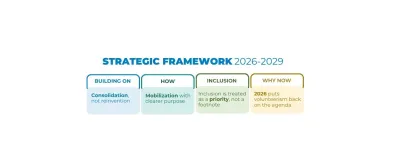
The new Strategic Framework marks a moment of consolidation rather than reinvention. After two cycles of steady expansion (2022-2025 and 2018-2021) more than doubling the number of UN Volunteers, achieving gender balance, increasing participation from developing countries, and improving disability inclusion—UNV now stands on solid ground. These gains are no longer goals to chase; they are the baseline from which the next chapter begins. Growth will not be measured in sheer numbers but in the strength of partnerships and in how effectively UNV supports the wider UN system.
This framework arrives at exactly the right time. The year 2026 has been declared the International Volunteer Year, a rare global spotlight on volunteerism. The strategy also spans the final stretch toward 2030—a period defined by the need to turn commitments into measurable results. UN Volunteers are uniquely placed to scale what works and help bridge what remains unfinished.
The focus is on two intertwined outcomes. Together, they reinforce the role of UNV as a system-wide service provider and a champion of volunteering as a key part of sustainable development efforts.
- Contributing to a people-centered United Nations by mobilizing skilled, diverse volunteers to support peace, development, humanitarian, and human rights efforts across the UN system.
- Promoting volunteerism globally through evidence-based advocacy, ensuring recognition of volunteer contributions and fostering inclusive policies that leave no one behind.
The results framework is streamlined—fewer indicators, clearer pathways, and a cumulative logic that focuses attention where it matters most.
Mobilization remains at the heart of UNV’s mission, but its purpose is now clearer and more practical. It emphasizes value for partners: faster deployments, greater flexibility, and lower costs. At the same time, the volunteer experience is elevated—ensuring quality assignments, support throughout the service journey, and stronger duty of care. Inclusion continues as a core principle, not a side note.
Tracking participation of women, volunteers from developing countries, and persons with disabilities is both a moral commitment and a practical necessity for reaching those furthest behind.
Beyond mobilizing people, the strategy turns outward to elevate volunteerism as a policy tool. UNV will help governments integrate volunteering into national plans, strengthen their ability to measure its contributions, and expand the evidence base—capturing not just economic outputs but also social cohesion, civic trust, and resilience. Evidence, in this framework, is not theoretical; it is meant to guide action.
Finally, efficiency takes on a new meaning—no longer the destination but the road that supports delivery. Four pillars underpin this: simpler operations, more agile structures closer to communities, better use of data, and a broader, more diverse funding base. Financial sustainability evolves from raising more money to widening the circle of contributors, reducing dependencies, and increasing resilience.
In all, the Strategic Framework signals a confident step forward: grounded in what works, responsive to a unique global moment, and ready to translate the power of volunteerism into meaningful impact during the critical years ahead.