



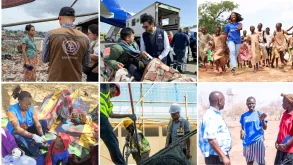
When crises hit—whether through war, disaster, or displacement—it’s not just infrastructure that collapses. Systems fracture. Communities scatter. The sense of safety disappears. In those moments, what holds the response together isn’t perfection, it’s presence. Across some of the world’s hardest hit places, from Sudan to Afghanistan to the Democratic Republic of the Congo, UN Volunteers have shown that effective emergency response begins with people on the ground: people who understand local realities, who act quickly, and who help communities move from shock toward stability. Under the UNV Strategic Framework 2026–2029, this frontline presence is not only preserved but strengthened.
A safety net and network multiplier
The war in Sudan, which erupted in April 2023, devastated communities, displaced millions, and intensified an already severe humanitarian crisis. A nationwide network of over 200 development volunteers had to pivot to survival mode overnight. “We had plans to scale up to 1,000 volunteers. In a matter of days, those plans collapsed. Suddenly, it was about survival,” recalls Baha Sharief, United Nations Volunteers (UNV) Country Coordinator in Sudan. To sustain this critical network, immediate action was taken: contracts were extended, evacuations arranged, relocation support offered, and counselling provided. Then came the real multiplier effect — through rapid, intelligent mobilization. Tailored offers were developed for nine UN agencies, using real-time intelligence from the ground.
“Informal conversations and networks were key,” Baha shared. In Sudan, the road is long. And the only way forward is together, volunteers, agencies, and communities. As one displaced father told me: “We don’t need promises. We need people.”
A community multiplier
When a catastrophic earthquake struck Afghanistan in August 2025, it killed thousands and displaced many more, burying entire villages under landslides. Among the first responders was UN Volunteer Adnan Safi, a United Nations Development Programme (UNDP) Area Project Manager who had previously led flood recovery efforts. Crossing the border from Pakistan into the hardest-hit districts of Kunar and Jalalabad, Adnan brought more than skills — he spoke the local languages, Pushto and Dari, and he understood the culture deeply, enabling a connection that external responders could not achieve. The recovery work began with clearing debris and restoring water access, but its true power lay in multiplying social resilience. He helped establish shelters, organized psychosocial support, and launched community kitchens — spaces that became more than sources of food. They became centers of strength, healing, and togetherness.
“When the earth trembles, it’s not only homes and roads that collapse, but also the sense of safety that anchors daily life,” Adnan shared. By meeting both physical and emotional needs, he transformed emergency aid into long-term human recovery — showing how presence can multiply not just aid, but the strength to begin again, together.
A multiplier of peace
In Beni, the Democratic Republic of the Congo—a region shaped by decades of conflict—UN Volunteer André Bifuko, a Project Management Assistant in the Disarmament, Demobilization, Reintegration and Stabilization Section, works with the United Nations Organization Stabilization Mission in the Democratic Republic of the Congo (MONUSCO), helping reintegrate ex-combatants and vulnerable youth through vocational training.
“Every training completed means one less person drawn back into armed groups,” André says. In one initiative alone, 200 people were trained in trades ranging from carpentry and tailoring to hairdressing and pastry-making. Among them were 65 former fighters and 135 community members — carefully balanced to rebuild trust between groups once divided by war.
Currently, André is overseeing the Muda wa Amani II project, which involves 400 beneficiaries — 111 ex-combatants and 289 community members — with nearly equal numbers of women and men. André’s work didn’t stop, despite the risks — some project sites were even attacked — but the multiplier effect continued. Each new skill sparks a livelihood. Each shared workshop becomes a place where mistrust dissolves and lives begin to rebuild.
These three examples show only a fraction of what volunteerism can deliver at scale. The new Strategic Framework positions volunteerism as a system-wide force multiplier: A broader, more diverse talent base; stronger UN‑wide partnerships; and volunteerism hard‑wired through evidence into development, humanitarian, and peace efforts—quietly, steadfastly, letting hope multiply on the frontlines.