



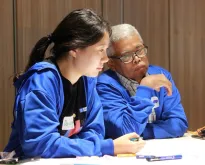
The Republic of Korea’s path to peace has taught it a powerful lesson: rebuilding isn’t enough—remembering matters. The Korean International Cooperation Agency (KOICA) supported an initiative in Timor-Leste to digitize the Chega National Center for Conflict Reconciliation and Peacebuilding. In partnership with the United Nations Educational, Scientific and Cultural Organization (UNESCO) Jakarta and INFORDEPE, the project turned painful history into a tool for learning, helping ensure the trauma of the Indonesian occupation is never forgotten—or repeated. Dayoung Jeong, a young Korean professional and fully funded UN Volunteer, helped carry this mission forward—combining personal growth and a commitment to peace through education.
Dayoung served as a UN Volunteer Education Associate in Timor-Leste from August 2023 to August 2024. She was driven by her dedication to UNESCO’s mission and the strength she admired in the Timorese people.
Dayoung reflects on how preserving the past can breathe new life into a place once defined by trauma.
“The Chega National Center in Dili, once a jail during the Indonesian occupation, now stands as a national symbol of remembrance and reconciliation. The memory of the war, the killings, and seeing people suffer has left deep trauma for many people in the country,” says Dayoung. “This project is about recovery, remembrance, and making sure that kind of violence never happens again.”
“This project had two main components,” Dayoung explains. “One part focused on the digitization of the Chega National Center—a process where our team faced a lot of challenges.” Scanning and uploading historical materials—videos, records, and paper documents—was time-consuming and required equipment like scanners and storage devices, which were not always easy to access in Timor-Leste. “One major issue was the internet connection,” she says. “It was really poor—it made any task involving uploading or syncing painfully slow. I wasn’t directly in charge of the digitization,” she adds, “but I saw my colleagues working tirelessly. It was difficult.”
While her teammates handled the technical work, Dayoung was primarily responsible for supporting teachers. She helped organize history teachers’ workshops—coordinating logistics, working closely with partners, and ensuring each session ran smoothly in collaboration with the Ministry of Education.
She also assisted the Project Steering Committee, working alongside KOICA and local authorities to monitor progress and prepare official reports.
Thanks to these efforts, 253 teachers from across all districts participated in workshops that encouraged open dialogue about the past. “The goal was to help history teachers better understand and reflect on their country’s history—and also to equip them to take the lead in peacebuilding education themselves,” Dayoung recalls. “History can look different depending on perspective,” she reflects. “It takes courage to sit together and talk about it honestly.”
One of her biggest challenges was language. As a foreigner, Dayoung had to learn Tetum to better connect with the community. “Even learning enough for simple conversations helped me feel closer to the beneficiaries,” she says. “It gave me a deeper understanding of the local context and culture.”
Through this process, she discovered the value of listening. She may not have understood every word, but she could still feel the emotion behind them. This sensitivity became especially important during the workshops. “You have to be careful,” she reflects. “For some, those memories are still very raw.” During one session, participants visited a site where many people had died. “You can’t just ask people directly about those things—it could be deeply hurtful, or even provoke anger.”
She learned that the best approach was to listen—to let people share their version of the past in their own words. “One person might say, ‘This is true,’ and another might say, ‘No, that’s not how I remember it.’ Each memory feels true to the person who carries it,” she says. “That can create tension, but also understanding—if we listen first.” This deeply human experience reveals just how complex and emotionally layered peacebuilding work can be.
One part of the initiative included Benchmark Training visits to Korea and Cambodia, where Timorese officials exchanged experiences on preserving historical memory—drawing parallels between the journeys of all three nations. They explored how acknowledging past conflicts within educational curricula can contribute to healing and reconciliation for future generations. Although Dayoung didn’t travel with the teams, she supported planning and coordination behind the event, contributing to the success of the exchange.
This work resonated with her on a personal level. “Korea also went through colonization and war,” she says. “I think that’s why KOICA finds meaning in supporting Timor-Leste. We remember our past—and we want to support others in their healing process.”
After completing her service, Dayoung joined World Vision Korea, where she continues to work on humanitarian projects.
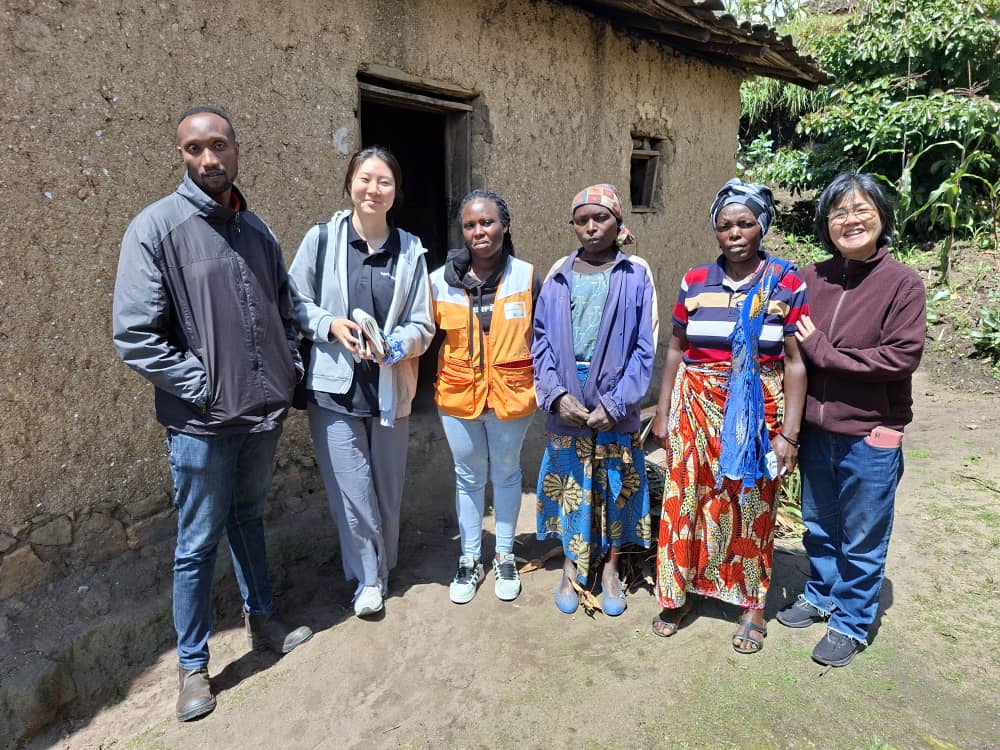
"I am currently serving as a Programme Officer with World Vision Korea, based in Seoul, where I oversee financial management and reporting for the KOICA Civil Society Cooperation project dedicated to improving the livelihoods of women-headed households living in extreme poverty in Rutsiro District, Rwanda."
She credits her time in Timor-Leste with helping her secure the role. “When you’ve experienced the reality of the field—limited infrastructure, cultural differences, and social tensions—you build the kind of on-the-ground skills that only real-world experience can teach.”
This story is part of a special feature marking twenty years of KOICA and UNV partnership. For more information about UN Volunteer assignments and how you can get involved, click here. To read our stories, click here.
The story was also published in Korean by KOICA.