



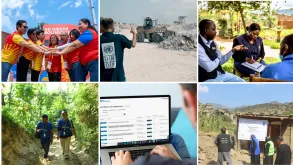
Physical and social isolation remain some of the toughest barriers to development. Whether caused by rugged terrain, digital divides, fragile infrastructure, or persistent violence, these separations cut people off from the opportunities they need to shape their futures. Yet every day, volunteers step into these gaps. They connect people through simple, human‑centered relationships that rebuild trust, spark collaboration, and help communities chart their own path forward.
In Zambia, the digital divide tells a broader story of exclusion. National networks continue to grow, but communities outside urban centers are often left at the margins of digital society and the modern economy. Women, young people, and older generations frequently feel this disconnect most acutely.
Closing this divide demands more than devices and infrastructure; it requires person‑to‑person support that builds confidence and helps people adapt to new tools and possibilities.
A turning point came in September 2025, when the Government of Zambia, supported by UNDP and UNV, launched a dedicated Digital Literacy Initiative. With 23 Starlink internet kits installed across 8 Youth Resource Centers and 10 Online Volunteers providing virtual training, connectivity was transformed into tangible skills. Young people in previously isolated areas now access digital literacy courses, entrepreneurship resources, and online safety lessons—gaining the confidence to start businesses, reach new markets, and safely participate in the digital world.
But the greatest distance is not always geographic. In Goma, the Democratic Republic of the Congo, survivors of conflict‑related sexual violence face another form of isolation—one rooted in trauma, silence, and broken trust. Here, UN Volunteer for Victims’ Rights, Laetitia Furaha, bridges a distance measured not in kilometers but in courage. Sometimes her work begins with a single phone call that says, You are not alone.
“Sometimes it’s a simple call to ask, How are you holding up today?” UN Volunteer, Laetitia explains. “That moment tells them they are seen, they are heard, they are not forgotten.”
Often working remotely when violence restricts physical access, Laetitia relies on her unique position as both a volunteer and a member of the community. “Communities trust me because I am one of them,” she says. “That trust is the first step toward healing.” A colleague from the United Nations Organization Stabilization Mission in the Democratic Republic of the Congo (MONUSCO)’s Victims’ Rights Unit adds, “Laetitia brings empathy and credibility that are hard to replace. Her presence helps survivors feel safe enough to share their stories. That’s where healing begins.”
Divides—digital, geographic, social, or emotional will not disappear on their own. But a different story is taking shape. Aligned with the UNV Strategic Framework 2026-2029, new digital platforms, expanding infrastructure, and deeply human approaches are converging to prove a simple truth: no one is too distant to reach, too isolated to include, or too marginalized to be part of the future we are building together.
And what becomes possible when every person can be reached—and every voice has space to be heard?