



There was a time—not very long ago—when suggesting that volunteerism could be measured felt inappropriate and utopian. Yet, measuring volunteerism is critical to making sure its contributions are visible, valued, and integrated into policy and development discussions. When we launched the first State of the World’s Volunteerism Report in 2011, I remember asking a very simple question: if volunteerism matters so much, why are we not measuring it?
The response was cautious, as some felt volunteerism was too intangible or rooted in solidarity to be captured by indicators, almost as if measuring it would devalue its contribution to a mere metric. I understood the hesitation, but I also knew that if something is not measured, it is too easily overlooked—and if it is overlooked, it is rarely recognized. After all, as the saying goes: “if you don’t count it, it doesn’t count”.
Why Measurement Matters Now
Looking at the 2026 edition of the State of the World’s Volunteerism Report, the change is clear. We are no longer debating if volunteerism can be measured; now, we are asking how to measure it well and why that matters for policy, communities, and development. Measuring volunteerism makes its contributions visible and ensures it is given priority in planning discussions. We are now halfway through the Sustainable Development Goals, facing overlapping crises in climate change emergencies, global conflicts, widening inequalities, growing poverty levels, displacements, and economic instability. Often, these challenges affect the same communities at once, and in many cases, volunteers are the first to act. This is precisely why the 2026 edition of the State of the World’s Volunteerism is so important.
I have seen this firsthand: after floods struck one community, the first responders were not external agencies, but local volunteers clearing rubble and checking on neighbours. Their hours and economic value went unrecorded, yet without their efforts, recovery would have stalled.
This is the paradox: volunteerism is often essential, but it is frequently invisible in policy frameworks. Yet measurement is not neutral—it shows what we choose to value. Therefore, if we value volunteerism, we must count it.
Beyond Counting Hours
For years, measuring volunteerism mostly meant counting hours and estimating economic contributions, which was an important start to challenge the idea that it was unimportant. However, hours do not tell the whole story, as they do not capture the trust rebuilt after conflict; the confidence a young volunteer gains; or how collective action reduces tensions. Volunteerism is not just donating labour; it is about establishing relationships and turning solidarity into action.
The 2026 report does not abandon quantitative measurement but instead expands it, combining numbers with meaning. By accepting this complexity, measurement frameworks now show the many transformational impacts of volunteerism.
From Transactional to Transformational
People often describe volunteerism in transactional terms, such as services delivered or outputs achieved. But during my years as UNV Executive Coordinator, I saw its transformational power: young people discovering their voice, communities reconciled through joint initiatives, and solidarity strengthening the community. These aren’t easily measured but matter deeply. Focusing only on inputs and outputs risks missing how volunteerism builds social cohesion and resilience. The 2026 report urges us to look broadly at the changes fostered by solidarity.
Volunteering is More Than ‘Just Doing Good’
I was also glad to see well-being included clearly in the measurement framework for the Global Index of Volunteer Engagement (GIVE) proposed in the report. There was a time when people thought well-being was too subjective, but today, progress is measured by more than economic growth.
Volunteerism supports well-being by building a sense of belonging, enhancing dignity, and encouraging purpose. By including these in measurement discussions, the report confirms that volunteer work changes the volunteers as much as the communities they help.
Recognizing Informal Volunteerism
Another major step is recognizing informal volunteerism, especially in the Global South, where mutual aid and informal networks underpin community resilience. This is also relevant because it allows us to finally recognize the voluntary contributions of women that would otherwise be only too easily overlooked. For too long, frameworks favoured formal models, but measurement must reflect everyday realities and major contributions.
Measurement Requires Ethics
Measurement is not simply a technical issue; it is an ethical one. Volunteerism takes place within systems shaped by inequality, and we must avoid romanticizing contributions that come from structural imbalances, such as the large share of unpaid care work done by women. The report recognizes these risks and examines how volunteerism relates to gender and crisis situations.
The Global Index of Volunteer Engagement (GIVE)
The introduction of the Global Index of Volunteer Engagement is an important milestone that shows the field has matured. GIVE looks beyond participation numbers to consider individual engagement, community impact, and the enabling conditions that encourage volunteerism. Volunteerism cannot thrive in a limited civic space, and the index highlights that it is both a civic action and a result of broader systems. However, an index is not the final goal; its value depends on how it is used in national planning and policy.
We must also remember that volunteerism cannot replace public responsibility. Measurement should strengthen accountability, as governments remain responsible for creating enabling environments and protecting civic space.
End Note
We used to debate whether volunteerism could be measured. That question is now behind us. Measuring volunteerism is no longer optional—it is essential. Not to reduce solidarity to numbers, but to prove its value.
To measure volunteerism is to recognize the quiet work that sustains communities and carries hope forward when institutions falter.
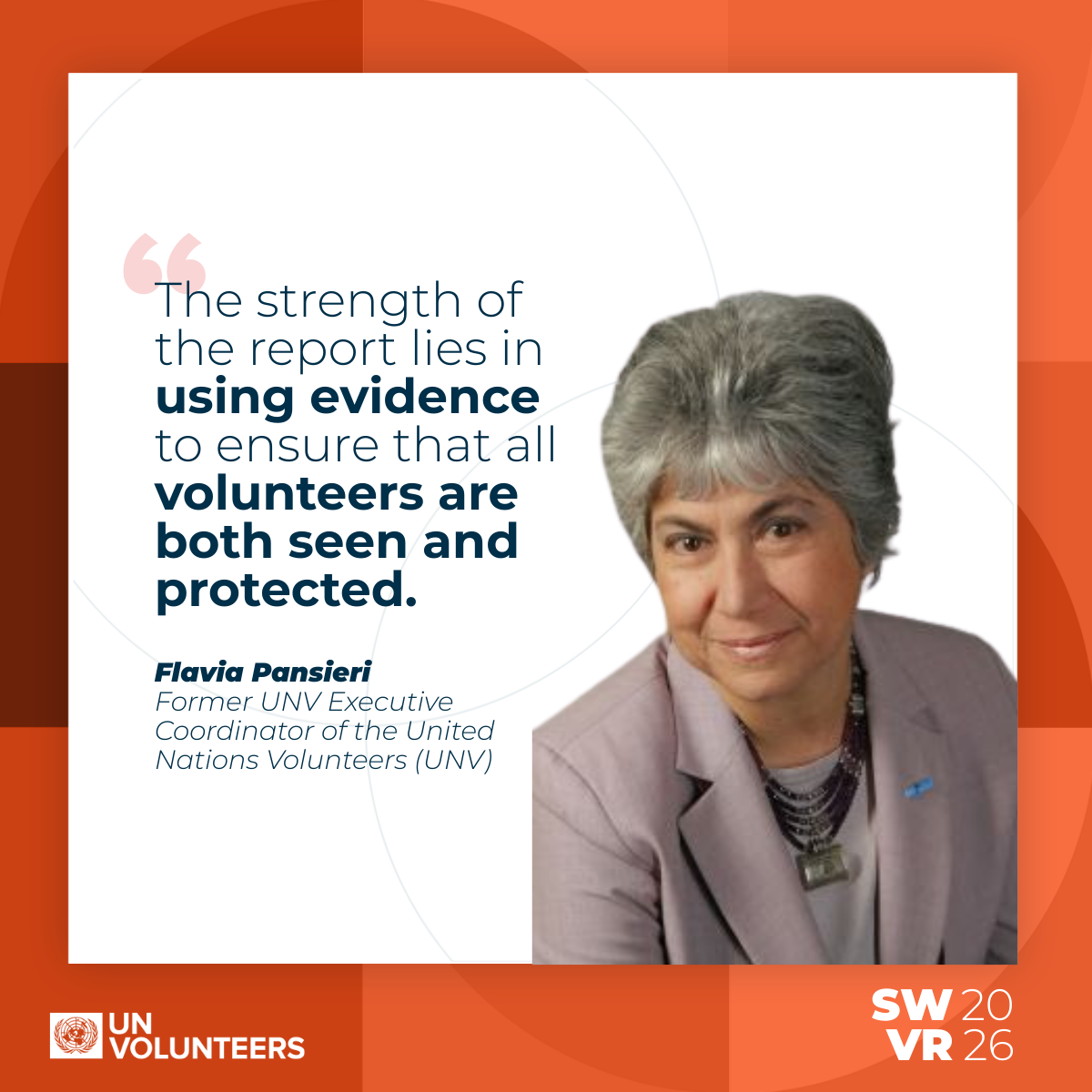
Flavia Pansieri served as the Executive Coordinator of the United Nations Volunteers (UNV) from 2008 to 2013, during which she initiated the first State of the World’s Volunteerism Report. A former UN Deputy High Commissioner for Human Rights, she has spent over 30 years leading international development and human rights initiatives, promoting the integration of volunteerism into global policy and sustainable development.