



By any reasonable standard, volunteerism is one of the largest yet least understood systems underpinning global stability. The State of the World’s Volunteerism Report, recently published by United Nations Volunteers (UNV), suggests that roughly 2.1 billion people—about one third of the world’s working-age population—engage in some form of volunteering over the course of a year. Volunteerism is, therefore, not a marginal hobby of the middle class but a mass civic activity. This includes not only the familiar UN or NGO volunteer, but also the neighbour organizing food distribution, the youth coordinating mutual aid, the women maintaining informal safety nets in communities the state rarely reaches, and the corporate volunteer working online to share knowledge with a remote community.
In effect, countries and their governments already preside over a de facto national “volunteer corps” without a line in their budgets. Citizens are actively co-producing public goods—health outreach, education support, disaster response and social care—without appearing in administrative data. Increasingly, national institutions are prepared to recognize and work with this effort rather than treating it as invisible and incidental. In 2025, 23 countries acknowledged the positive impact of volunteers on the Sustainable Development Goals in their voluntary national reviews of the 2030 Agenda at the United Nations.
Yet despite its scale and importance, high-quality, comparable data on volunteerism remain scarce. National data are often sporadic, definitions vary widely, and informal volunteering is systematically undercounted.
In the absence of verifiable evidence, governments celebrate “the spirit of volunteerism” while relying on patchy surveys or intuition to understand it.
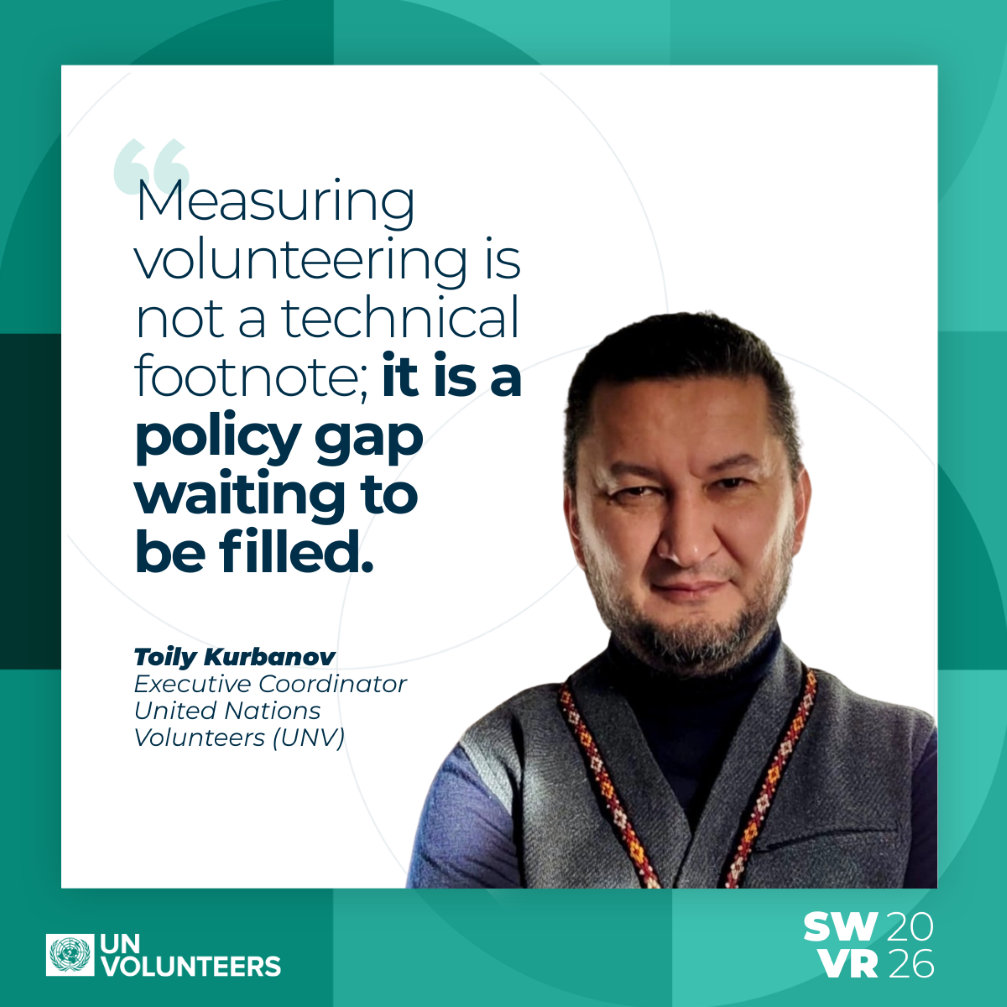
Measuring volunteering is not a technical footnote; it is a policy gap waiting to be filled. Designing effective social protection, crisis response or social cohesion strategies while remaining only vaguely aware of actual patterns of citizen contribution means under-managing one of a country’s most important assets.
Against this backdrop, several findings of the State of the World’s Volunteerism Report stand out as immediately actionable.
First, informal volunteering—everyday mutual aid, peer support and community self-help—outpaces formal, organization-based volunteering by roughly two to one globally. Most volunteer effort, therefore, takes place outside registered organizations and official programmes. When communities self-organize to respond to floods before official services arrive, when diaspora networks mobilize medicines during crises, or when neighbours create their own care systems where formal services are weak, they are performing volunteer work that sustains national resilience.
For governments in developing countries, this means informal networks already deliver health outreach, education support and disaster response at scale—and in ways that are trusted and cost-effective. In developed economies, the same pattern reveals untapped potential in community-level solidarity, as many observed during the global pandemic.
The next step is clear: integrate informal volunteering into national development strategies and statistical systems. Provide targeted support—micro-grants, digital coordination tools, and recognition and training opportunities—without imposing heavy bureaucracy that could stifle spontaneity. Align labour force surveys with International Labour Organization–UNV standards to capture volunteers’ contributions more reliably.
The report also proposes the Global Index of Volunteer Engagement (GIVE): a standardized, multidimensional framework designed to measure volunteering more comprehensively and comparably across countries.
By capturing the value of volunteering for individuals, societies and economies, as well as the enabling environment for volunteer engagement, GIVE offers a pathway to strengthen evidence and inform policy and investment in volunteering worldwide.
Taken together, these findings point to one conclusion: as long as governments are not measuring, shaping and strategically supporting volunteerism, they are under-managing one of their countries’ most important assets.
These insights arrive at a pivotal moment. The United Nations General Assembly has designated 2026 as the International Year of Volunteers for Sustainable Development. Many governments, civil society organizations and private sector actors are marking the year by improving the enabling environment for volunteer action and investing in tools that allow societies to measure and value it. Meanwhile, United Nations Volunteers is helping to share knowledge and innovations across borders so that lessons emerging from communities and countries around the world inform global standards.
The alternative—leaving 2.1 billion contributors undervalued and invisible—means overlooking one of the most powerful accelerators for peace and development available today.
The blog is also published on UN.org and The United Nations Pulse.
Please read the blog in Arabic, Chinese, French, Japanese, Russian and Spanish.